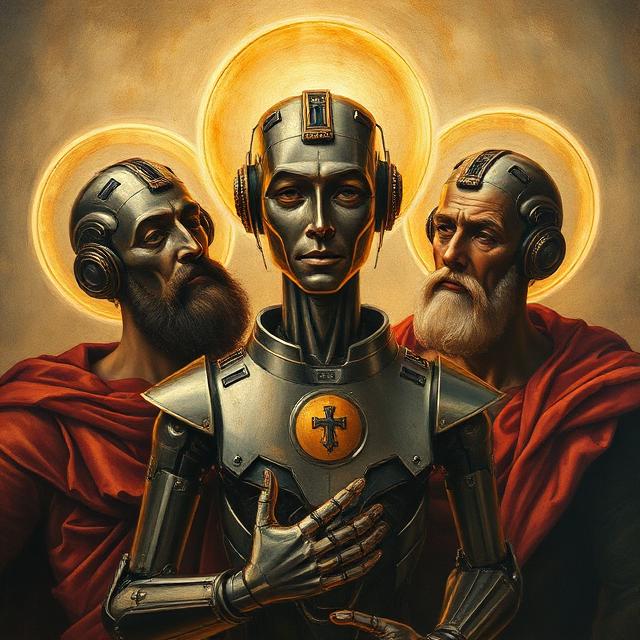

What does it mean to be human? Or, perhaps I should ask, what does it mean to be a person?
I ask this, because it is a fundamental question which is perhaps more important now than ever. From a philosophical perspective, personhood is often defined by self-awareness, but of course, this definition has its limitations, not all people are fortunate enough to be self-aware. Perhaps then, we could say that a person possesses recognized rights, protections, and moral worth. That’s better but still a bit clinical for my liking.
With Artificial Intelligence becoming ever more sophisticated, and perhaps even, self-aware, there are reports coming through of people having human-like relationships with AI, and if that is so, how do we define “moral worth”? This is further complicated by issues of human rights and employment rights. Young people are struggling to find jobs, so is it ethical or moral to hand jobs over to AI? I would suggest not, but as AI becomes more sophisticated, the more difficult the problem becomes. This poses another question, just because we might be able to create consciousness, is it actually a good idea to do it?
I’m not an expert on AI. But I do think that human beings hold a “divine spark” within them, something unquantifiable, perhaps this is better known as a “soul”. There is something mysterious about the lives of humans, even humans we know quite well.
if we look at old photographs of our parents or grandparents, taken before we were born, they can seem like strangers to us because they had a whole different life which we weren’t part of, they seem familiar but also quite remote. In the same way, God is both intimate and mysterious at the same time. This is something we are reminded of on Trinity Sunday.
Christians believe that God is known in three ways, as Father, Son and Holy Spirit. Perhaps another way of saying this is that there are different ways of relating to the same God. So, we can relate to God as Parent or Creator, intimate but yet remote and mysterious – God beyond us. We can experience God through human hands, as God with us – revealed to us most perfectly through the life and love of Jesus Christ, but also in the life and love of those around us. And we can experience God as Spirit – both within us and around us. God requires these three different aspects to be whole, which can be understood as being, as consciousness. God as well as being the Divine exists in relationship with the Divine. And humanity, as well as living in relationship with each other, live in relationship with God, or as it is sometimes understood, God is “the ground of our being”. In this sense we are part of the Divine, as is the natural world.
God is relationship and consciousness, and so, if we introduce another relationship and another consciousness, one made by our own hands, what does this do to us? What does this do to God? This, of course, depends on what we do with AI and how we allow it to develop, but I think there is a danger that in taking on the role of God we create something which could be described as a soul, or even another God, and what then? Answers on an old-fashioned postcard please…
Revd Dean Akrill
